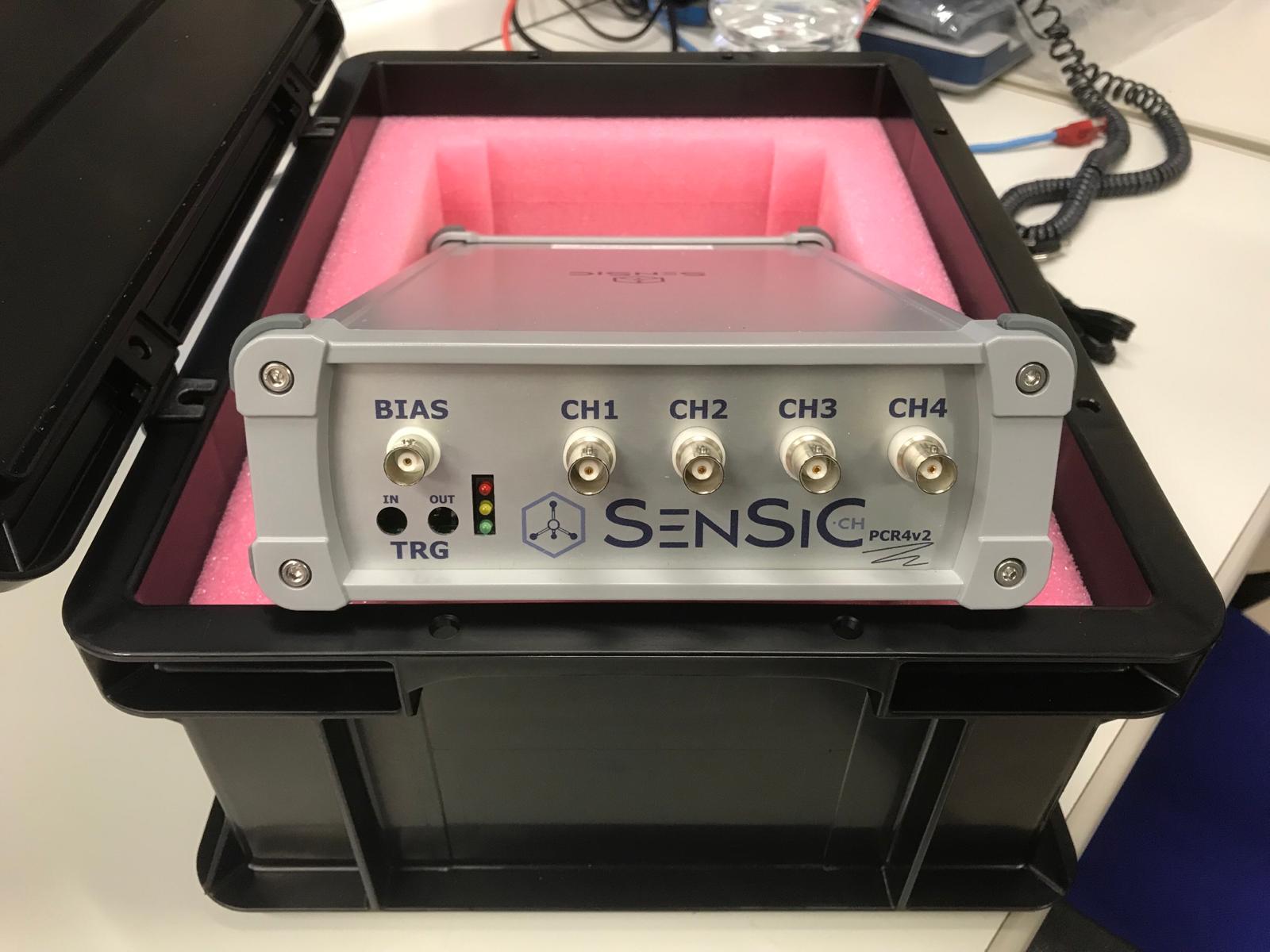
The SenSiC Beamstopper-Integrated Sensor (BIS) is a silicon carbide-based active beamstop designed for X-ray beamlines where beam interception and real-time diagnostics are required in the same compact device.
Unlike conventional passive beamstops, the BIS generates an electrical signal when irradiated by the X-ray beam. This allows the beamstop position to become an active diagnostic point, providing information on beam presence, relative intensity, and, in the 4-quadrant configuration, beam position.
More than a beamstop
In scattering and diffraction experiments, the beamstop is placed at a critical location: directly downstream of the sample, where the transmitted primary beam must be safely intercepted. In a conventional setup, this component is passive, but the SenSiC BIS changes this concept. By integrating a SiC sensor into the beamstop assembly over a thick tungsten piece, the device can provide an electrical readout related to the intercepted beam. This enables real-time monitoring without adding a separate diagnostic element into the experimental layout.
This is particularly valuable in compact end-stations, high-brilliance beamlines and experiments where space, alignment stability and diagnostic reliability are critical.

Available configurations
Intensity Beamstopper
The intensity configuration provides a beam-induced current signal related to the intercepted X-ray flux.
It is suitable for beam presence detection, relative intensity monitoring, beamline commissioning, and diagnostic logging during scattering, diffraction, or imaging experiments.
4-Quadrant Position-Sensitive Beamstopper
The 4-quadrant configuration integrates four independent SiC sensing regions into the beamstopper.
This allows the beamstopper to monitor the position of the transmitted or post-sample beam while still performing its primary beam-interception function.
| Single pixel (intensity monitor) | Four pixels (position monitor) |
| 0.5mm x 0.5mm | 2mm diameter |
| 0.8mm x 0.8 mm | 3mm diameter |
| 2.0mm diameter |
The reported BIS footprints are currently in the 2–3 mm diameter range, with four separate quadrants in the position-sensitive version. This ultra-compact footprint makes the BIS suitable for integration close to the sample, detector or scattering path, where conventional diagnostics may be too large or difficult to install.

Robust and compact integration
Each BIS can be mounted on a thin PCB with encapsulated electrical contacts, providing robust external connections through flat cables and LEMO interfaces.
The wirebond-free bonding approach improves mechanical robustness and simplifies handling during installation, alignment, and routine operation. This packaging concept is designed to support practical beamline integration while preserving the ultra-compact footprint of the active beamstop.
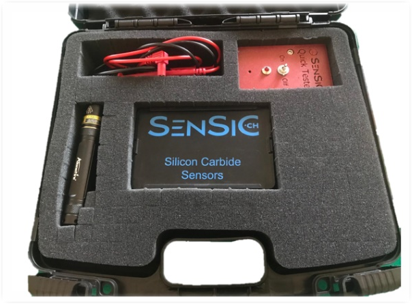
Each sensor package includes all necessary tools for signal readout, ensuring easy and straightforward installation:
(i) the sensor,
(ii) the connector to LEMO, SMA or BNC, upon request,
(iii) a “quick tester” and
(iv) a “UV torch” to check the sensor functionality during the installation.