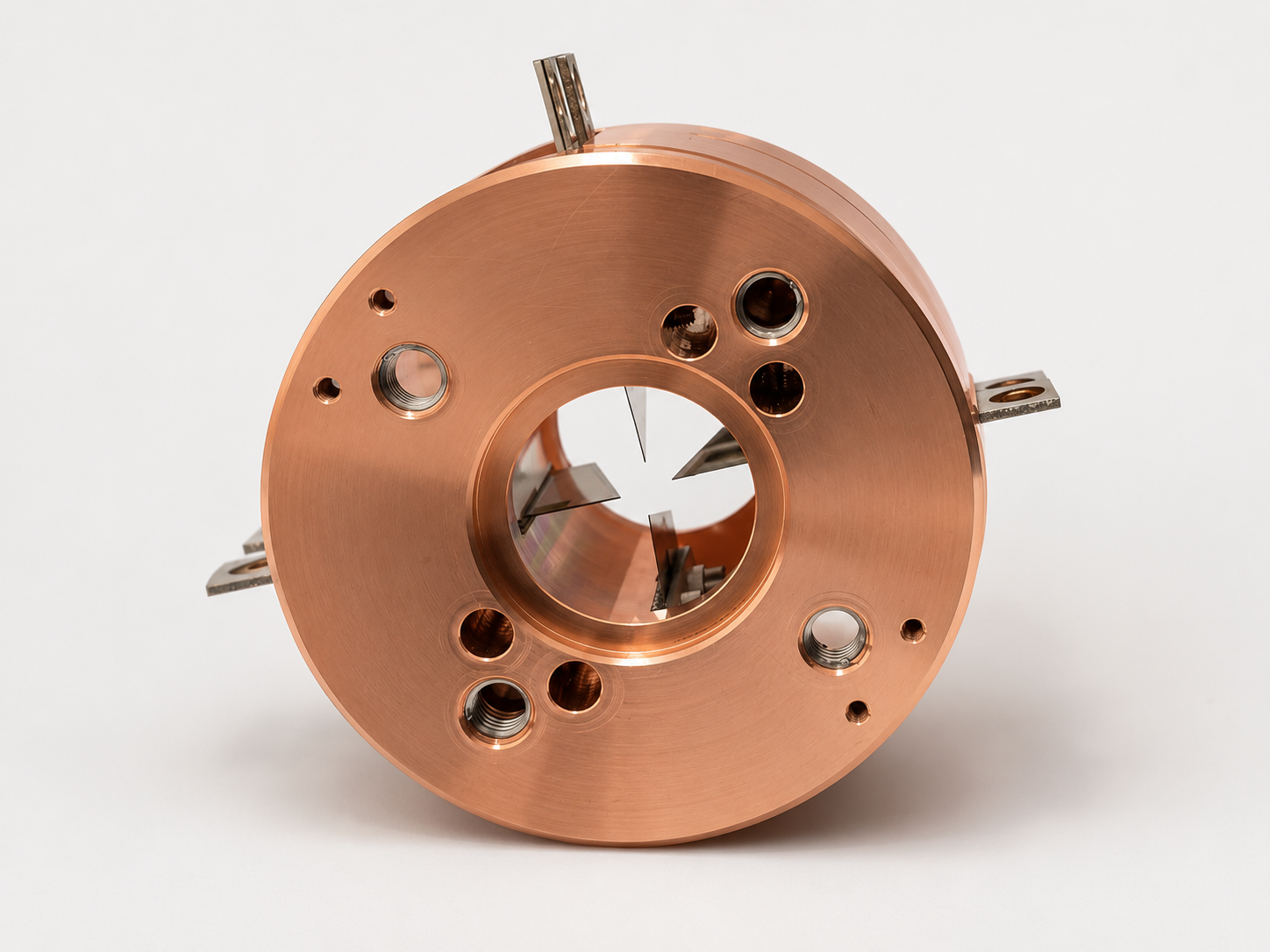
SenSiC SiC aperture BPMs are designed for real-time monitoring of white and pink X-ray beams in synchrotron front-ends and beamline diagnostic sections.
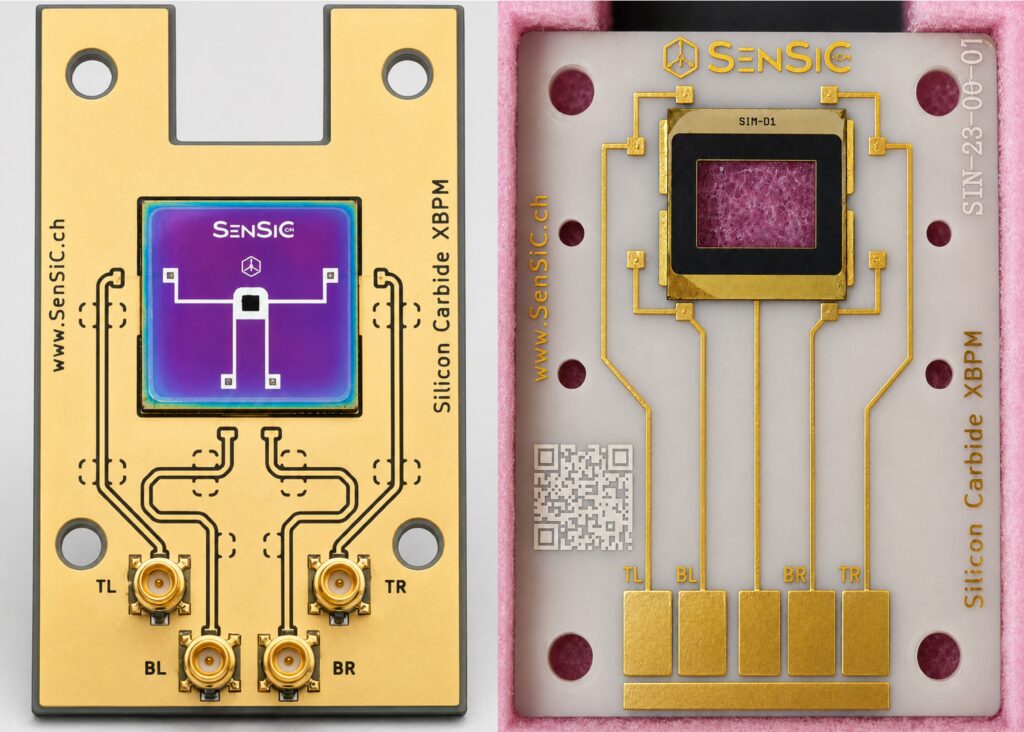
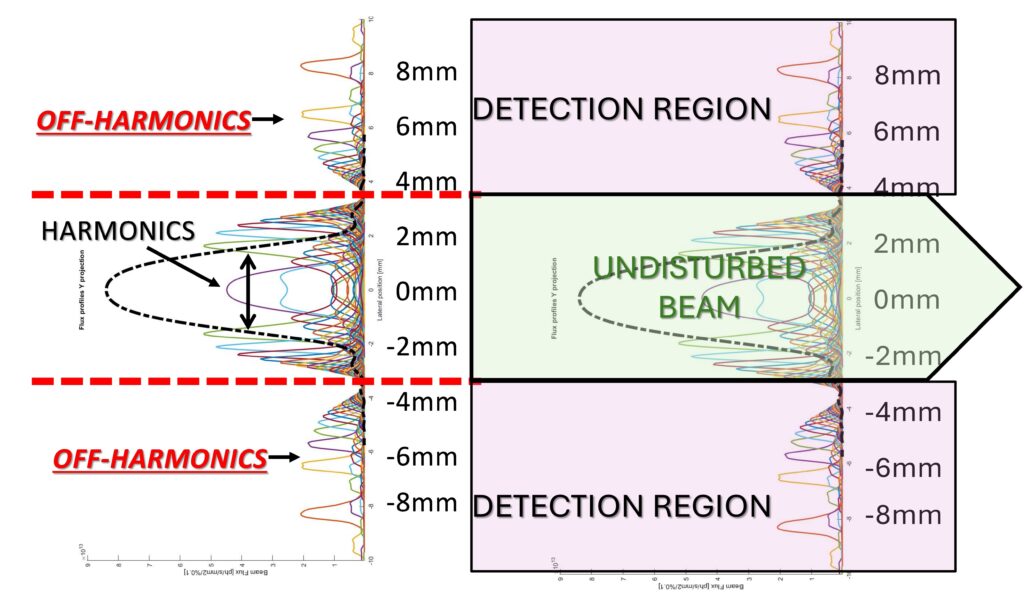
Unlike other detectors, the device is based on a non-fully intercepting geometry: the main beam can pass through a central aperture, while the SiC sensing regions collect beam-induced current from the beam edges or selected peripheral regions. This allows the system to provide information on beam position and relative intensity while preserving the transmitted beam path.
The technology is based on silicon carbide semiconductor sensors, providing radiation hardness, thermal robustness and stable operation in high-flux X-ray environments.
Designed for next-generation synchrotron stability requirements
Diffraction-limited storage rings and upgraded synchrotron sources impose increasingly demanding requirements on photon beam stability. Higher brilliance and reduced emittance make real-time monitoring of beam position, intensity and shape essential for maintaining beam quality at smaller sample targets. SenSiC SiC aperture BPMs address this need by providing compact, radiation-hard and contamination-insensitive diagnostics for white and pink beam operation.
Compact and flexible aperture geometries
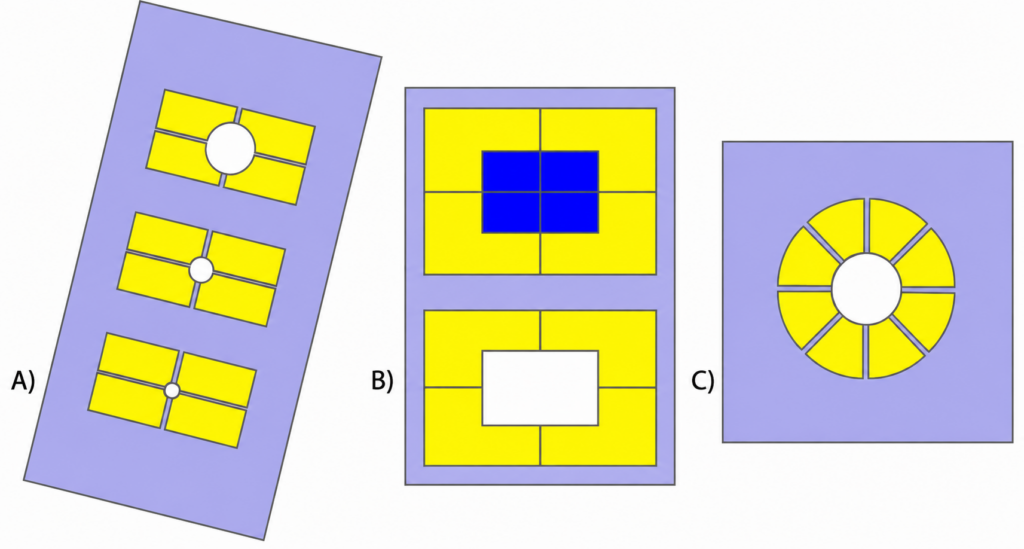
A key advantage of this platform is the possibility to adapt the aperture and electrode geometry to the beamline installation. Possible geometries include square apertures, circular apertures, rectangular openings and segmented sensing layouts. These configurations allow the device to be optimized for different beam sizes, photon-energy ranges, alignment requirements and available space.
Position, intensity and beam-shape information
By comparing the current collected by different sensing regions, the system can extract position-related information in horizontal and vertical directions. The total collected current can be used as an intensity-related signal. This makes the device suitable not only for routine monitoring but also for beamline commissioning, alignment, stability evaluation, and fast orbit feedback system, aimed at improving X-ray beam stability for experiments.
White beam and pink beam operation
SenSiC SiC aperture BPMs are intended for beamline environments where the diagnostic device must operate under high photon flux and broad or partially filtered spectral conditions.
For white beam applications, the sensor can be used in front-end sections where robustness, heat-load tolerance and contamination-insensitive response are critical. For pink beam applications, the same non-fully intercepting architecture can support beam-position and intensity monitoring after spectral filtering or beam conditioning, where high flux is still present but the beam must be preserved for downstream optics or experiments.
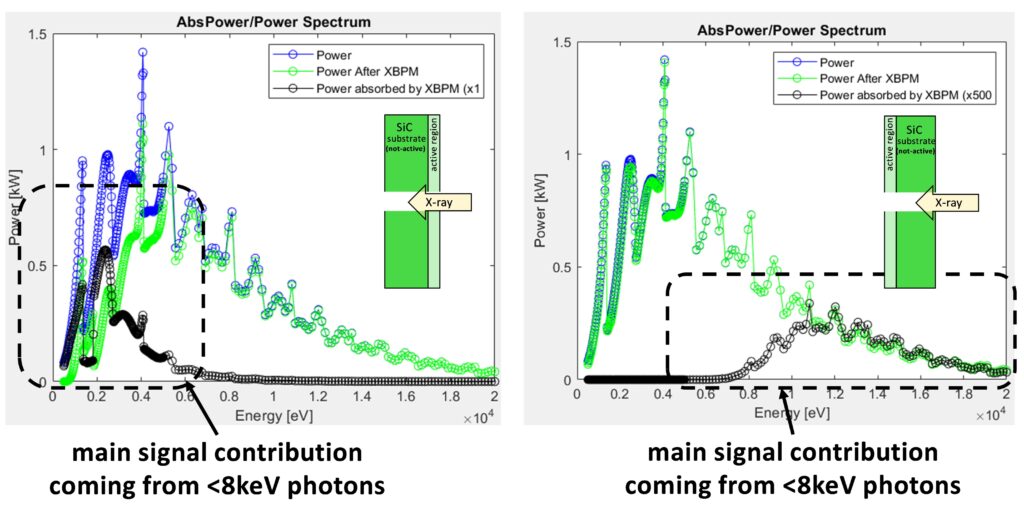
In a standard orientation, the sensor signal is largely dominated by low-energy photons. By changing the device configuration, the inactive SiC substrate acts as an intrinsic spectral filter. This reduces the contribution of soft photons and makes the sensor response more selective to the harder part of the white or pink beam.
Integrated with SenSiC PCR4 readout
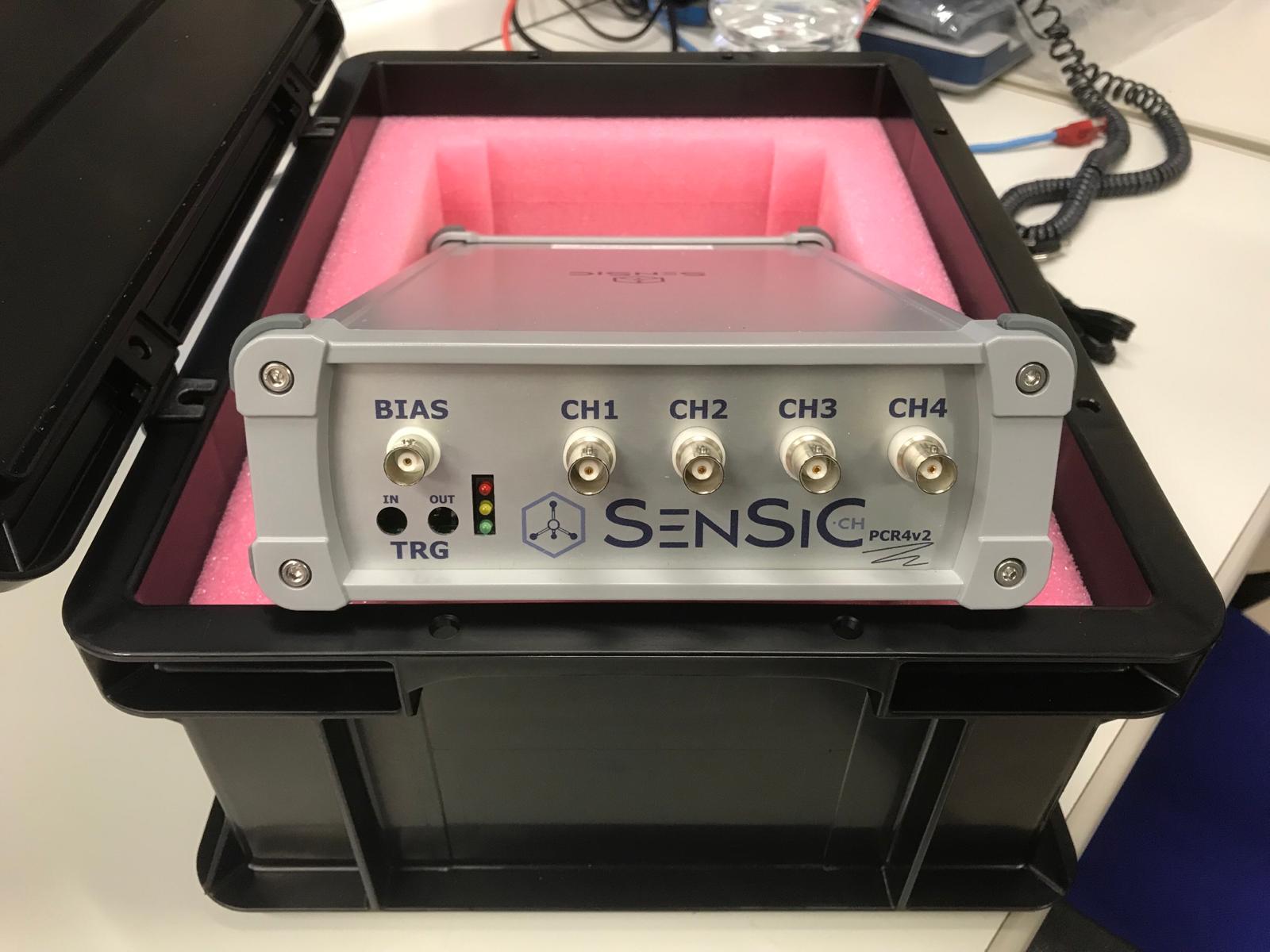
The SiC aperture BPMs can be used in combination with the SenSiC PCR4 readout system. The PCR4 combines a dedicated transimpedance input stage for current sensing with analog signal conditioning and filtering, measuring currents from the fA range up to ±50 mA, to cover all the necessities in several beam monitoring applications.