Solid-state detectors for ultra-high dose rate beam dosimetry and monitoring
FLASH Radiotherapy relies on the delivery of therapeutic doses at ultra-high dose rates (UHDR), introducing demanding requirements for dosimetry and beam monitoring.
Conventional ionization chambers can suffer from significant ion-recombination and saturation effects under these conditions, making the development of alternative detector technologies essential for reliable UHDR beam characterization and FLASH research.
Why Silicon Carbide?
Silicon Carbide combines high radiation hardness, fast charge collection, a wide bandgap, and the possibility of tailoring the detector active volume to the specific application.
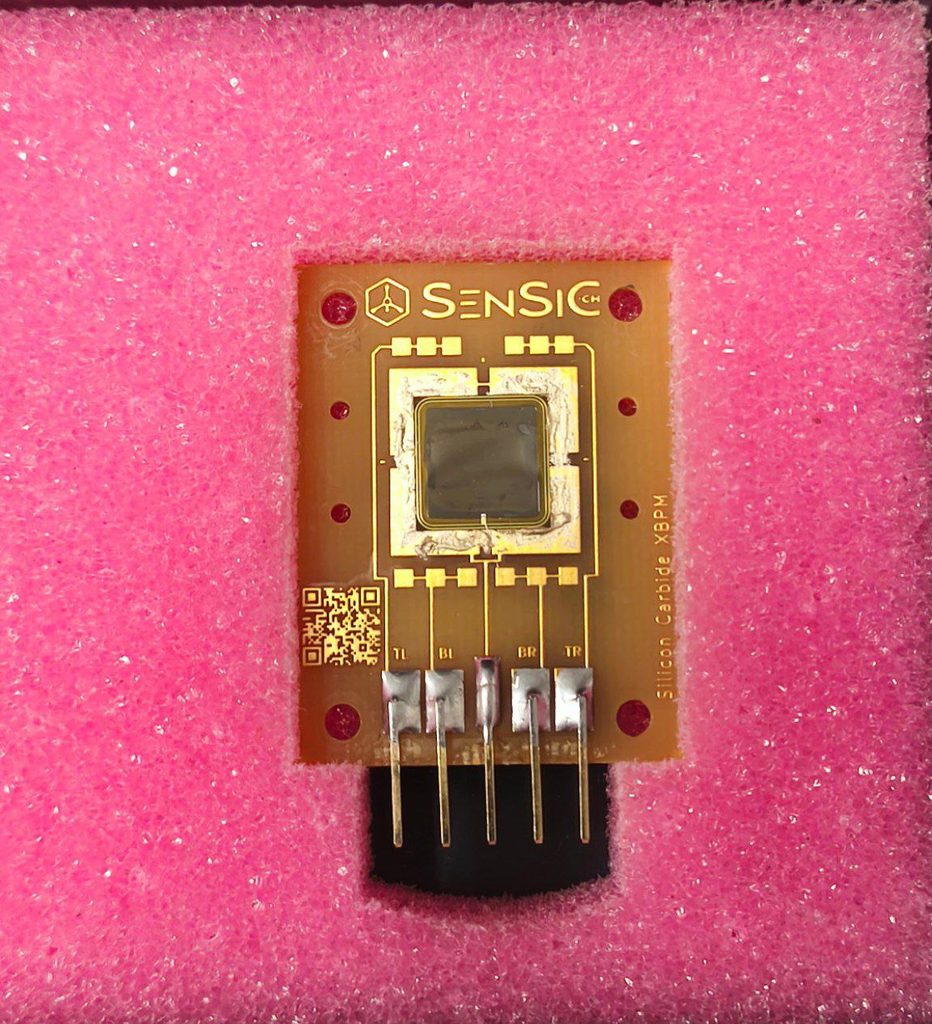
In collaboration with INFN – Catania Section we have developed and tested in several FLASH-RT research centers different 4H-SiC detector configurations for dosimetry and real-time monitoring of UHDR beams.
The first experimental characterization demonstrated the capability of SiC detectors to operate under 9 MeV UHDR electron beams, showing a linear response with dose per pulse and excellent stability even after an accumulated dose of 90 kGy.
Operating in the FLASH regime
A detector for FLASH research must remain reliable under irradiation conditions far beyond those encountered in conventional radiotherapy.
Our SiC detectors have been progressively optimized to operate across a wide range of ultra-high dose rate conditions while preserving a highly linear response even at very high dose per pulse.
Experimental campaigns demonstrated linear operation up to 21 Gy per pulse, corresponding to instantaneous dose rates of approximately 5.5 MGy/s, with no evidence of saturation within the investigated range.
These results establish SiC as a robust solid-state platform for UHDR beam characterization, dose-per-pulse measurements and real-time monitoring.
Beyond dose: looking inside each FLASH pulse
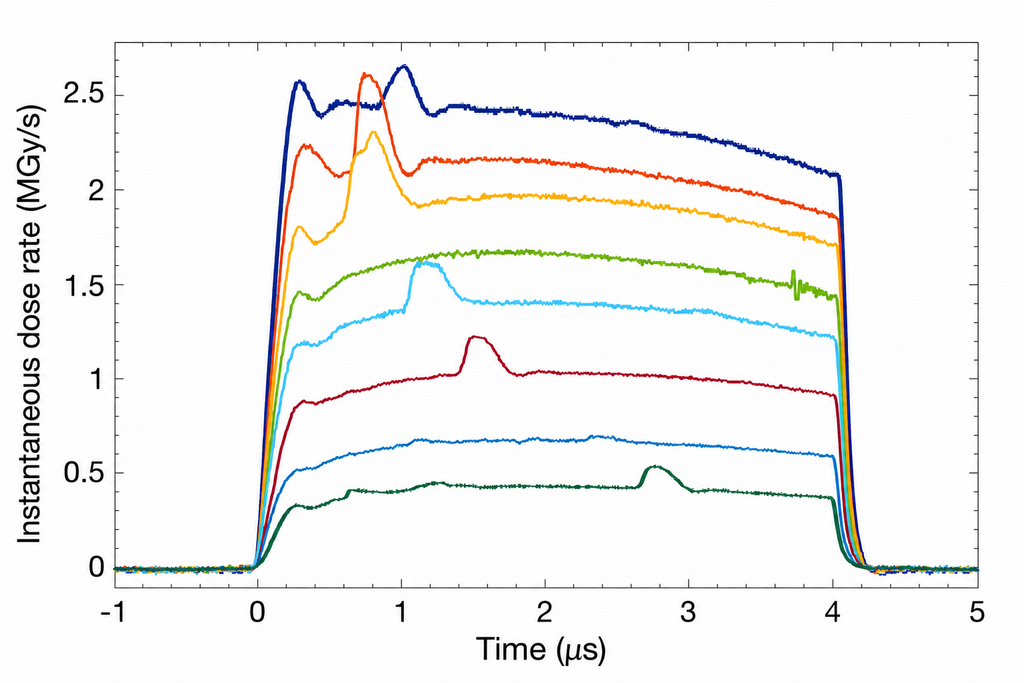
SiC detectors can provide more than an integrated dose measurement: their fast response allows the temporal structure of individual UHDR pulses to be investigated.
The response of our detectors has been compared with dedicated AC Current Transformers used for accelerator monitoring, showing strong agreement and demonstrating the capability of SiC to resolve individual electron pulses.
The same detector platform can therefore provide access to:
• Delivered dose and dose per pulse
• Instantaneous intra-pulse dose rate
• Pulse duration and temporal structure
• Beam stability and reproducibility
From detector prototypes to complete dosimetry solutions
Moving from detector characterization to realistic measurement environments requires more than optimizing the SiC sensing element itself.
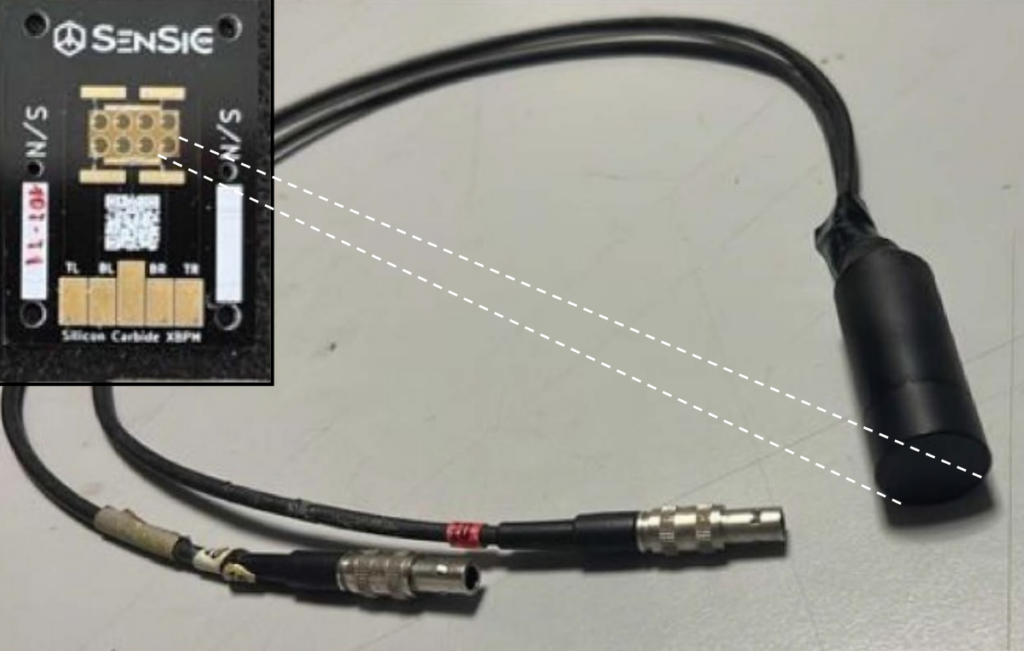
We therefore developed an encapsulated and waterproof SiC detector, enabling measurements directly in water phantoms and under reference dosimetry conditions.
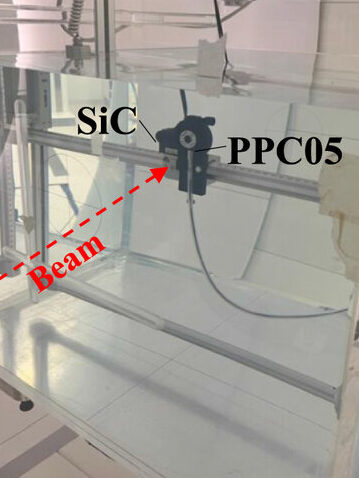
The detector has been characterized with both UHDR electron and proton beams, with dose-distribution measurements showing agreement with a FLASH diamond reference detector within approximately 1% under the investigated conditions.
The same SiC technology is also being extended toward new detector architectures, including ultra-thin free-standing devices for fast UHDR monitoring and multi-channel arrays for high-spatial-resolution beam profiling and Quality Assurance.
What are we working on now?
Our current R&D activities focus on turning these experimental results into increasingly integrated and application-oriented measurement solutions.
Current developments include:
- Detector optimization – active volume, geometry and sensitivity
- Packaging and integration – waterproof and application-specific detector heads
- Fast readout – pulse-resolved acquisition and real-time monitoring
- Multi-channel systems – beam profiling and Quality Assurance
The detector technology has already been extensively validated under UHDR irradiation conditions and is currently available for R&D collaborations and application-specific developments, while work continues toward increasingly integrated and standardized measurement solutions.
Interested in evaluating SiC detectors for UHDR or FLASH research?
Contact us to discuss detector configurations, beam tests and collaborative R&D developments.
Selected scientific publications
| First Characterization of Novel Silicon Carbide Detectors with Ultra-High Dose Rate Electron Beams for FLASH Radiotherapy Applied Sciences, 2023 DOI: 10.3390/app13052986 | Comprehensive dosimetric characterization of novel silicon carbide detectors with UHDR electron beams for FLASH radiotherapy Medical Physics, 2024 DOI: 10.1002/mp.17172 |
| Silicon carbide detectors for dosimetry and monitoring of ultra-high dose rate beams Journal of Instrumentation, 2024 DOI: 10.1088/1748-0221/19/03/C03064 | Systematic Study of Silicon Carbide Detectors and Beam Current Transformer Signals for UHDR Single Electron Pulse Monitoring Radiation Research, 2025 DOI: 10.1667/RADE-24-00139.1 |
| Dosimetric characterization of an encapsulated waterproof silicon carbide detector with UHDR electron and proton beams for FLASH radiotherapy Physics in Medicine & Biology, 2025 DOI: 10.1088/1361-6560/ae0860 | Characterization of SiC free-standing membrane with UHDR electron beams as real-time dosimeters for FLASH radiotherapy Journal of Instrumentation, 2026 DOI: 10.1088/1748-0221/21/03/C03033 |