From detector technology to an integration-ready beamline component
Developing a high-performance beam monitor is only part of the challenge. In a synchrotron beamline, installation also means dealing with vacuum compatibility, mechanical constraints, electrical connections and detector alignment.
Our current R&D activity aims to simplify this process by turning our SiC resistive X-ray Beam Position Monitor (rXBPM) into a compact, quick-mount system designed for easier integration into existing beamlines.
A different approach to beam position monitoring
Beamline diagnostics often require precise mechanical positioning to ensure that the beam remains within a relatively narrow optimal region of the detector. The rXBPM architecture helps relax this constraint.
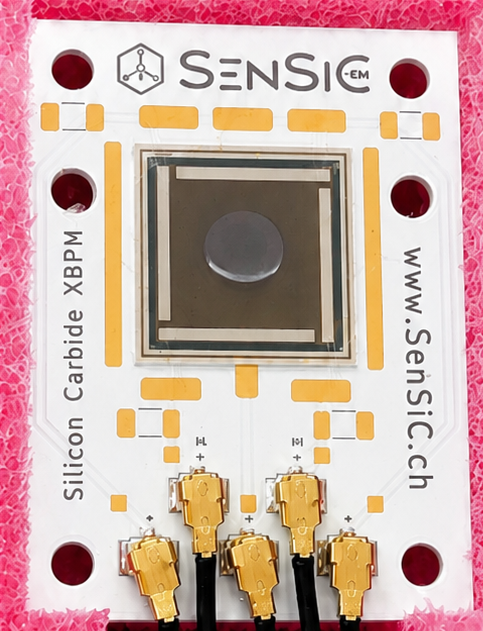
Unlike conventional segmented XBPMs, where the position signal strongly depends on how the X-ray beam overlaps the individual electrodes, the rXBPM uses resistive charge division on a continuous layer to reconstruct the beam position.
This architecture enables simultaneous monitoring of beam intensity and position while providing an extended linear response region and a position sensitivity intrinsically independent of the beam spot size.
From the sensor to a quick-mount assembly
We are now extending these detector-level advantages to the complete mechanical and electrical integration.
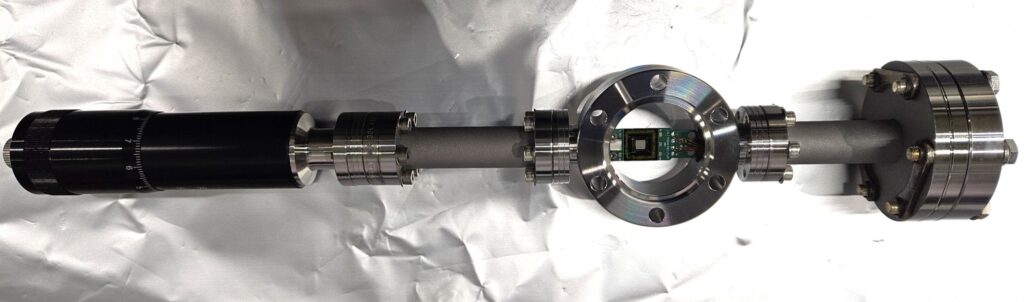
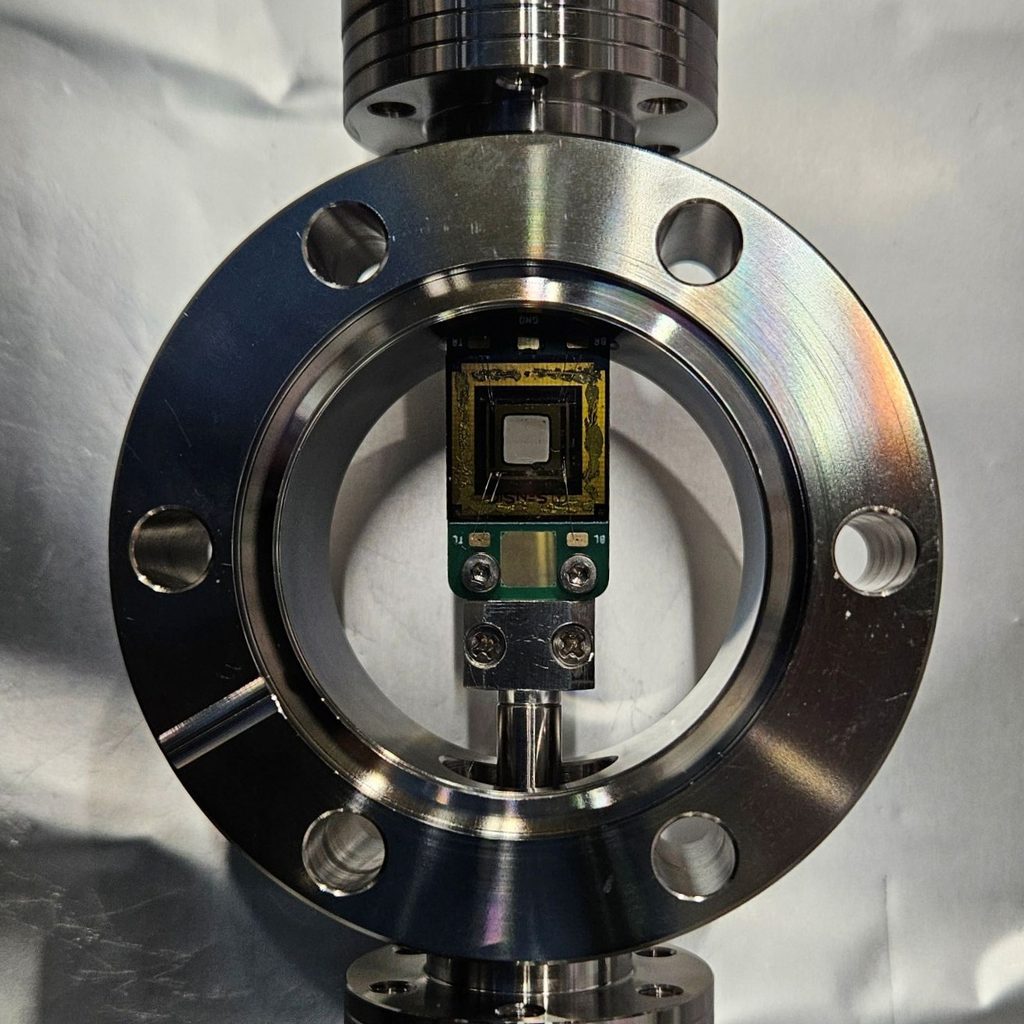
The first rXBPM Quick-Mount assembly combines:
- the free-standing SiC rXBPM sensor;
- a dedicated electrical interface PCB;
- vacuum-compatible mechanical components;
- a linear motion feedthrough to place the sensor in the beam path and remove it from the trajectory;
- a compact architecture designed to simplify installation into an existing vacuum system.
The objective is to reduce the amount of custom engineering normally required to introduce a new beam-position diagnostic element into a beamline.
Rather than providing only the sensing element, we are working toward a ready-to-integrate diagnostic module, where the detector, electrical connections, and mechanical interface are conceived as a single system with a minimal thickness of less than 5 cm.
Towards plug-and-integrate beam diagnostics
The underlying rXBPM detector technology has already been developed and experimentally validated. The next step is to reduce the engineering effort required to bring that technology into an operational beamline.
The Quick-Mount project is therefore focused on bridging the gap between a high-performance detector and a practical beamline component that can be installed, connected, and commissioned with minimal modification to the existing infrastructure.
Interested in testing an rXBPM or evaluating its integration into your beamline?
Contact us to discuss beamline requirements, mechanical interfaces and collaborative R&D activities.
Scientific reference
SiC resistive X-ray beam monitor for intensity and position control of synchrotron light
Journal of Synchrotron Radiation, 33 (2026), 995–1004
DOI: 10.1107/S1600577526005242